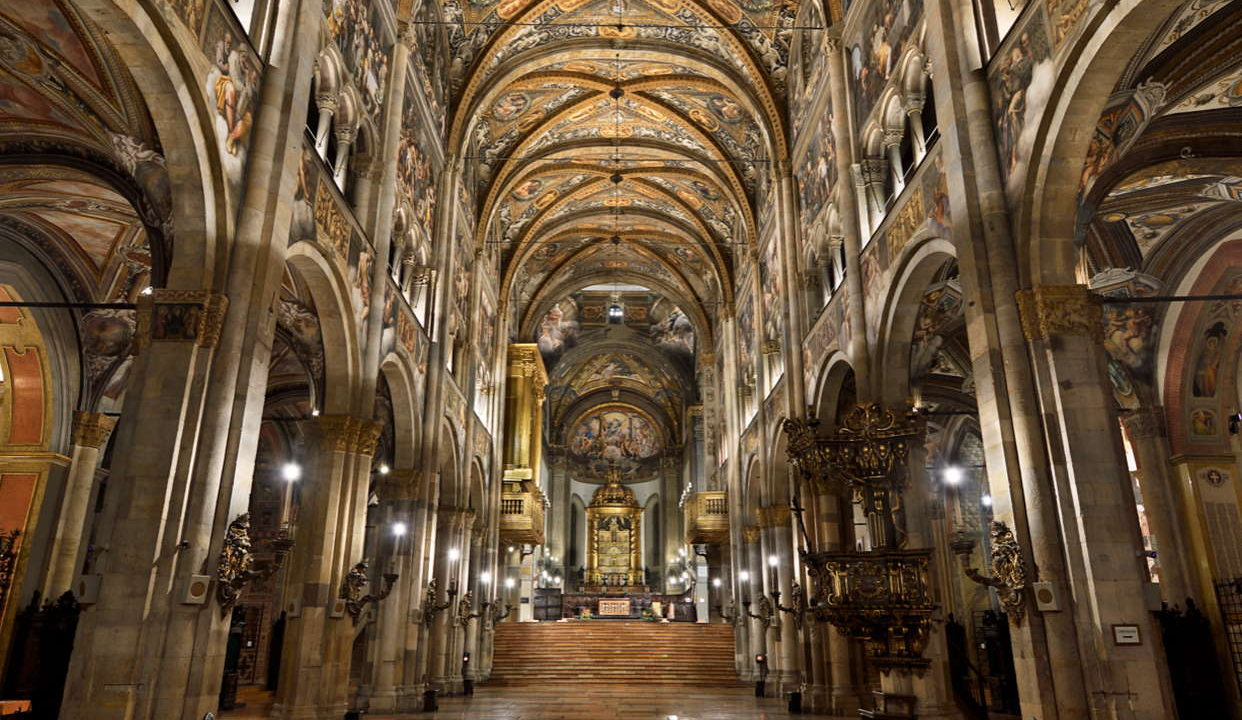
The nave
Facing the presbytery, where the rites are performed, the nave is the part of the Cathedral where people congregate for services. The processions of the Bishop and clergy pass through the nave, through the congregation, where light and shadow from the matronea (women’s galleries) and high windows create different patterns from one hour to the next.
The pulpit
Visitors entering the Cathedral for the first time are immediately struck by the imposing baroque style pulpit in richly gilded carved wood, supported by the third column on the right. It was made by local carpenter Paolo Froni in 1613.
The vault
Around 1555, Bedoli Gerolamo Mazzola presented his design for the cross vault. The painter wanted to create a lavish, lush, highly structured design. At the centre of the rib vaults, busts of the prophets trace a sort of aerial path towards the Christ figure in the apse. Aligned in pairs, monochrome figures topple large vessels, from which rivers of abundance flow.
The capital of the Madonna
This capital is clearly visible at the Cathedral entrance, on the second pillar on the left. Recent works have restored this medieval bas-relief polychromy of the Mother of Christ, dressed in a red tunic and blue cloak. Seated on a throne, she is depicted without the baby Jesus, which was unusual for the era. In prayer, she faces God, but also the people entering the Cathedral, ready to intercede for believers.
The Christian Initiation capital
Situated on the fourth pillar in the left-hand lateral nave, this capital is barely visible. It depicts a baptismal font, behind which stands a minister: he is handing a baptised child to the mother of godmother. Depicting just a few essential features, the whole scene symbolises the Christian initiation in its three Sacraments: Baptism, Confirmation and the Eucharist.
The donkey capital
Clearly visible, even from the ground, particularly in the morning, is an unusual and ambiguous scene. A donkey and two wolves are seated like people and dressed in monks’ habits. The donkey is the teacher, and holds a coarse whip in his hand. The two students, the wolves, one facing the teacher, the other facing the opposite way, have open, snarling mouths. The Latin inscription reads: He who beats the unholy donkey too harshly is the monk made wolf, shown here on the right path.
The organ
In the last aisle on the left, above the presbytery, is the church organ. The wooden case was carved by Marco Genesio Callegari and gilded by Giovanni Maria Varani. It was designed by Girolamo Bedoli Mazzola and made between 1557 and 1562. The first organ was made by the Antegnati organ makers in Milan. Responding to changing musical tastes, in 1786, the instrument was completely remade by the Serassi organ makers in Bergamo in 1786, by melting and recasting the original pipes.