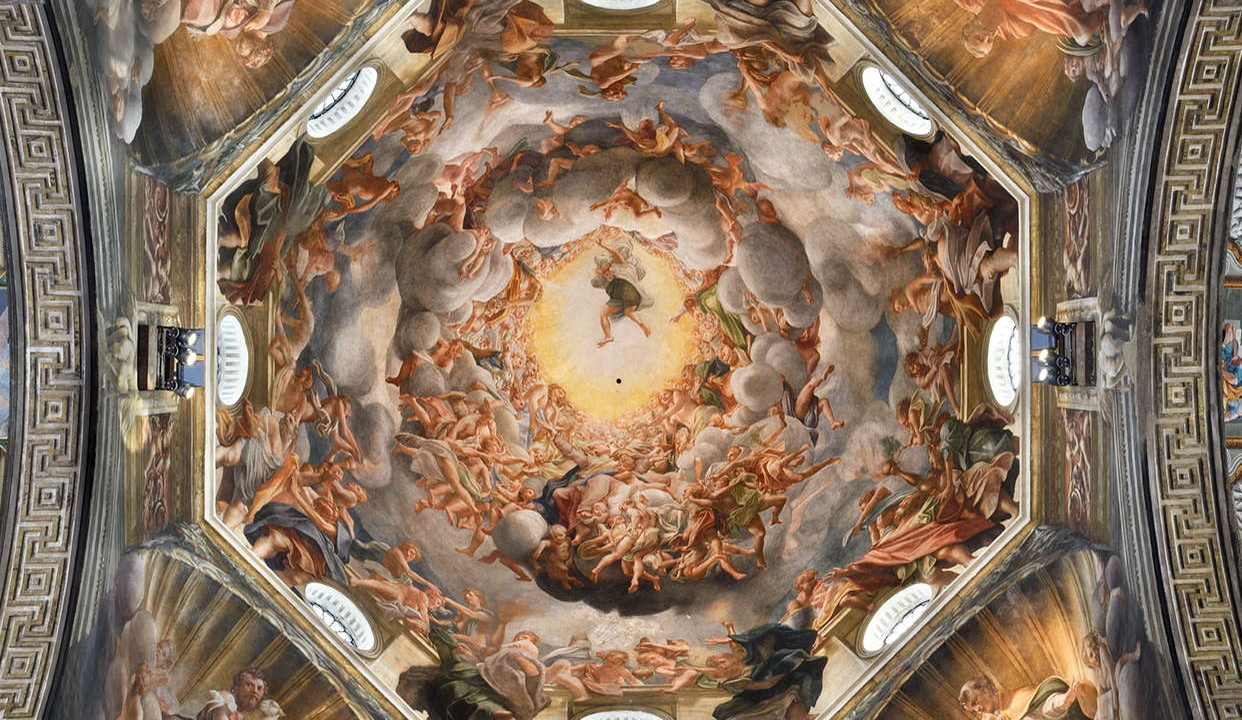
The dome

Correggio's Assumption of the Virgin is a grandiose work of perspective, in which light, composition and movement are combined to create an illusionistic masterpiece.
Correggio's Assumption of the Virgin is a grandiose work of perspective, in which light, composition and movement are combined to create an illusionistic masterpiece.
The history of the piece
Early-16th-century Parma was an extraordinary hotbed of cultural creativity, which found artistic expression in several forms and figures, particularly Antonio Allegri, known as Correggio, who painted the frescoes in the church of San Giovanni Evangelista, the private chamber of Abbess Giovanna Piacenza in the Convent of St Paul, and the Assumption of the Virgin in the dome of the Cathedral. On 3 November 1522, the artist was commissioned to begin work on the dome, the undersides of the arches and the walls of the choir, although he only began work at the end of 1530. He was unable to complete the project before dying in 1534.
Narrative and perspective
The story of the Assumption of Mary is not found in the New Testament. Instead, the apocryphal writings described the event in mythical terms for the purposes of edification and as a response to devotional questions. Correggio’s underlying theological principle is the image of Mary as inseparable from the Son, who welcomes her here into heaven. The figure of the open-armed Virgin dressed in a pink robe and blue cloak is positioned on the westerly side of the dome, towards the apse, and is visible to those who stop at the foot of the great staircase on their way along the nave. This was what the faithful could see at Correggio’s time. This space was dedicated to them, whilst the higher levels, the transepts and the choir were reserved to the clergy and city authorities, before Antelami’s layout was changed in 1566.
The Apostles
The Apostles are present at the event, having been collected from the countries where they were preaching the gospel and brought to Jerusalem by the angels. In the dome, Correggio has painted the Apostles standing in pairs on white marble cornices in the corners of the octagon, hiding its geometry and thereby providing a circular frame for the composition.
Adam and Eve
From among the wall of faces surrounding Mary emerge the full busts of the progenitors: Adam on the left, cleared of condemnation and Eve on the right, holding an apple with a green shoot: the apple no longer representing condemnation and pain, but salvation.
Joseph
Joseph is located to the left of the Virgin, holding a staff and a lily.
Biblical figures
Keeping our gaze to the left, after Adam we see Abraham and his son Isaac with the sacrificial lamb. Further to the left is a figure whose bust is elevated above the surrounding heads, partially covering his face with his hand, past which we can still see his thick blonde hair: this is David, resting his hand on the Philistine giant Goliath’s severed head – painted to a larger scale than all the others – killed by the future king of Israel. The figure with the great beard between David and Abraham could be the patriarch Jacob. Finally, near David’s knee, there is an old man with a beard painted in profile and holding a bunch of grapes: Melchizedek.
The other female figures
To the left of Mary are two female figures: two women, one wearing a flowing green and red robe. These are most probably Martha and Mary, the sisters of Lazarus and witnesses of his resurrection. Next to them are three faces, possibly Mary Magdalene, Mary of Clopas and Salome – the first to reach the tomb on the morning after the Sabbath – and finally Judith and her maidservant holding the severed head of Holophernes.