The narrative
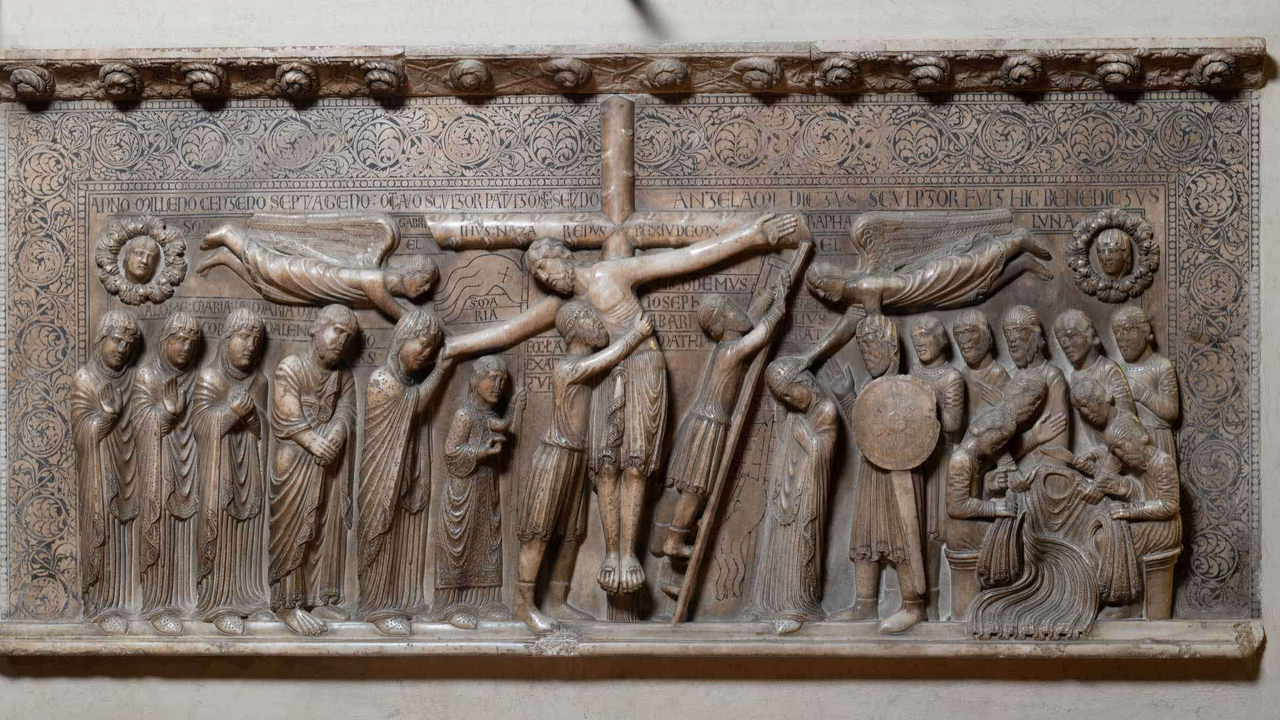
Usually described as simply depicting the Deposition, the panel in fact represents several events that took place at different times. Christ’s agony on the Cross and the soldiers casting lots for his clothes; Jesus’ death and the confession of the centurion; the deposition and entombment for three days; and, finally, the declaration of the Resurrection from the women who go to the tomb on the morning of the first day of the week, after respecting the day of rest on the Sabbath. The viewer is also made a participant in the story, which is brought into the contemporary age with the figures of the sun and moon, which symbolise the passing of time, and in the image of the Church, which continues to bestow the grace merited by Christ.
The Cross
The central Cross, formed by two pieces of wood, divides the narrative in two. However, that is not to say the good is on one side, the bad on the other. It is more complex than that. The wood of the Cross is adorned with gemstones signifying the flowering of a new beginning, that is, a tree of life, as suggested in Revelation, which refers to lignum vitae (22,2); a prelude to resurrection. The horizontal piece of the Cross bears the inscription: Ihesus Nazarenus | rex Iudeorum. The left hand of Jesus is still nailed to the Cross. Nicodemus is standing on a ladder and extracting the nail using pliers – now missing. Joseph of Arimathea supports the body of Jesus, encircling his arms around Christ’s waist and, in a powerful, immensely tender gesture, resting his face on the side with the wound from the soldier’s spear. The other arm, already taken down, is supported by the Archangel Gabriel (Gabriel), who lays Christ’s hand on the face of his mother Mary.
The right-hand side
On the viewer’s right, the Roman centurion stands and confesses the divinity of Christ, pointing with his hand. Behind the centurion stand five nameless men, mute witnesses of Jesus’ death. In the corner, in the foreground, are four soldiers, depicted in the act of dividing up Christ’s clothing.
The left-hand side
To the left, Mary, John and the women stand at the foot of the Cross. They are accompanied by the first witnesses of the Resurrection who, the morning after the Sabbath, go to the tomb to anoint Christ’s body with perfumes, and instead find it empty: Salome, Mary of Clopas and Mary Magdalene. The faces, the hand gestures, the robes, the composure and figurative harmony of this group creates a sense of the drama and truth of a liturgical act, in contrast to the more fragmented group on the right, which seems to evoke a sense of disturbance and uncertainty.
The Synagogue
Two other figures are carved onto the panel on a smaller scale, perhaps to suggest a foreground and to invite an interpretation beyond description. On the right, between Nicodemus and the centurion, is the Synagogue with its standard thrown down, lowering its head before the Archangel Raphael.
The Church
On the left, between Joseph of Arimathea and Mary, is the Church, its standard raised, bearing a conspicuous cross. It is clothed in liturgical dress, the dalmatic, and holds a chalice in its right hand. The two figures, positioned symmetrically, symbolise, in the Synagogue, the end of the first covenant, and, in the Church that replaces it, its primary role in the salvific economy as a depository of the grace merited by Christ’s sacrifice on the Cross.