The niches

The internal perimeter of the building is marked by sixteen niches containing important cycles of votive frescoes.
The internal perimeter of the building is marked by sixteen niches containing important cycles of votive frescoes.
The first niche of the altar
The main niche in the iconographic programme of the Baptistery is the one behind the altar, facing east. It is the only niche that preserves in their entirety the Romanesque paintings in the Byzantine style. On the left, Daniel in the lions’ den with the tamed animals, representing Christ persecuted and risen, and Habakkuk bringing food to the prophet. In the centre of the lunette, within the “almond”, symbol of infinity, is Christ Pantocrator enthroned. Around him are the symbols of the four evangelists, while on either side are two angels defeating the dragon, symbol of the devil. On the wall is the classic baptism scene of Byzantine iconography.
The second niche: the Crucifixion
In the second niche is a fine fresco by an artist from Lodi depicting the crucifixion, with Saint James, the Virgin, Mary Magdalene, Saint John the Baptist and Saint Anthony the Abbot. In the lower band a “Madonna of mercy” commissioned, as the inscription says, by the Consortium of the Living and the Dead in 1408.
The sixth niche – Saint Francis
Most of the wall features the fresco of the Nativity by artists from Bologna, which can be dated to around 1340: Christ blessing with Mary and Joseph is adored by the shepherds alerted by an angel. On the left, Saint Francis of Assisi portrayed according to an unusual and ancient iconography: he is presented in conversation with the seraphim and the tetramorph cherubim, he has no stigmata on his hands and side, and he is not barefoot. It was only after Bonaventura’s biography, composed in 1263, that the image of Francis as alter Christus would take over especially without stigmata.
The seventh niche – Christ, baptism
The fresco on the wall of the seventh niche, by a painter from Bologna, is divided into two parts. On the left the risen Christ, in a white robe, shows the wounds of the crucifixion. On the right a baptism of Christ, with a small variation on Byzantine iconography: John the Baptist lays his left hand on Christ’s head, while with his right he draws water from the Jordan River. In the lower part, the scene of a deacon who baptizes a child by immersing his head in the font located in front of the niche. The same font is present in the second scene, the Baptism of the Emperor Constantine.
The eighth niche – Madonna enthroned
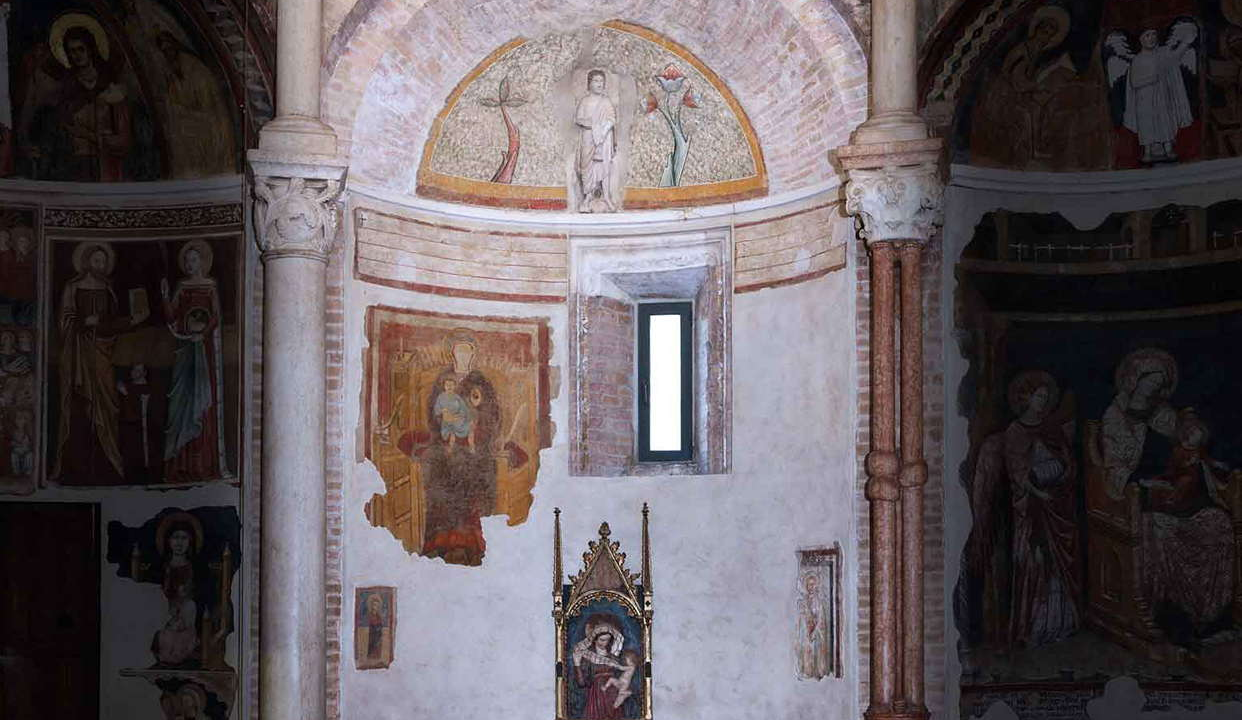
In the eighth niche, the Madonna enthroned nursing the Child with Saint Erasmus (holding the candle), John the Baptist and Magdalene, the work of an early 14th-century painter from the Milan area. Underneath, portraits of John the Baptist, Bernardo da Chiaravalle and a bishop saint, perhaps Saint Bernard degli Uberti, patron of the Diocese of Parma, painted by Niccolò da Reggio and dated around 1340.
The niche of the west portal: King David
Inside the west portal we find a bas-relief of key importance in the apocalyptic and Christological context. King David, a figure that refers to Christ, wearing a gold crown and gold-bordered royal clothes, and holding a harp that must also have been golden.
The tenth niche: the Presentation of Mary in the Temple
Antelami’s sculpture shows the Archangel Gabriel delivering God’s message to Mary, whose figure is carved in the next conch. The painting is of the Presentation of Mary in the Temple, with Joachim and Anna, as described in the apocryphal gospels. On the walls of the niche are scenes of the Passion of Christ painted by Niccolò da Reggio. In the last band at the bottom left, is the work of a painter from Parma, Saint Ursula with her virgins companions and the circumcision of Jesus.
The eleventh niche: the works of mercy
The frescoes of the eleventh niche are divided into different sections. At the top left, Christ rising from the tomb supported by Mary, a work by Niccolò da Reggio. On either side two prophets: Zechariah and Isaiah. In the centre, the Holy Face of Lucca by a painter from Parma. In the panel below is the young Jesus who in a dream sees the angels showing him the instruments of the Passion. Underneath, the seven works of mercy are depicted. The figure in the lower left is Saint Christopher holding a budding staff and carrying Baby Jesus on his shoulders across the river. In the lower right is Saint Leonard holding shackles, a plastic example of an operator of mercy dedicated to the liberation of slaves, and Saint Octavius. On the upper right of this wall, a solemn Saint Catherine of Alexandria with the wheel of her martyrdom, attributed to Buffalmacco (1336), the famous protagonist of Boccaccio’s Stories.
The niche of the north portal: the flight to Egypt
In the internal niche of the north portal is a sculpted representation of the Flight to Egypt of the Holy Family. The Archangel Gabriel points out the way to the group consisting of Saint Joseph with his traveller’s staff from which hangs a vase with water, Mary riding on the donkey, holding a pomegranate, the symbol of suffering, and in her lap the Baby with the scroll of the Scriptures in his hands.