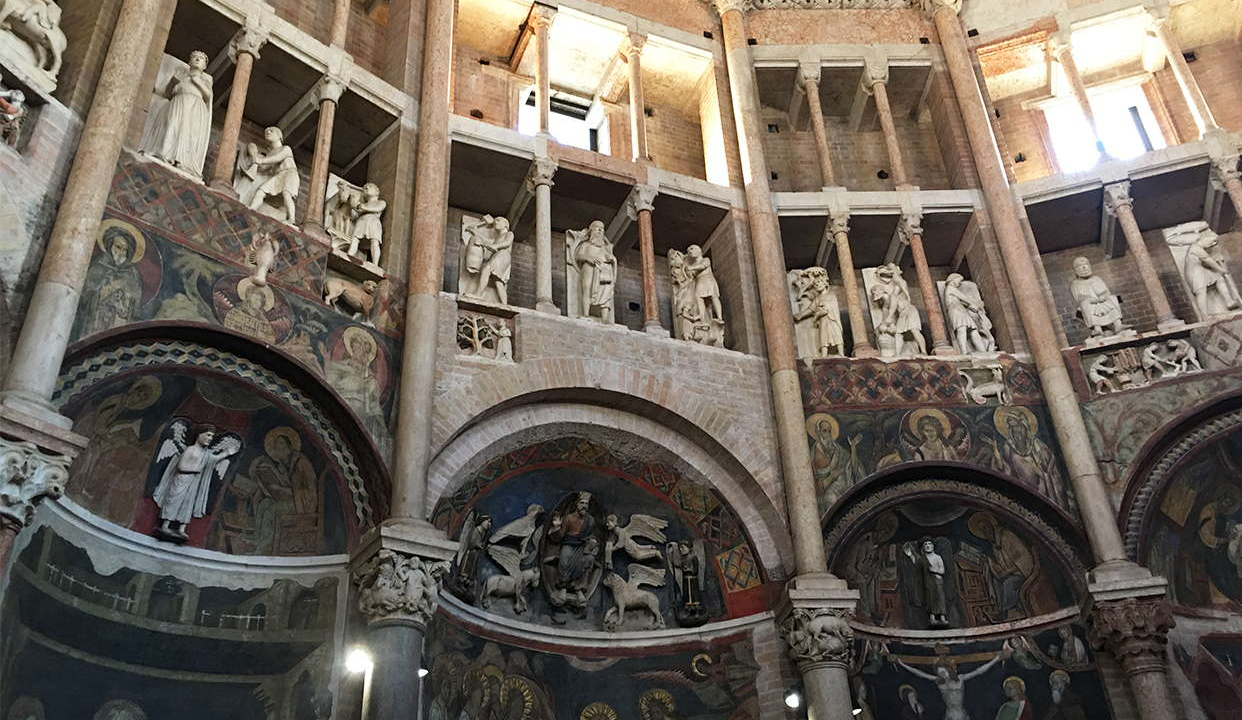
The Cycle of the Months by Antelami

In the first gallery on the eastern side there are 14 anthropomorphic statues representing 12 months and two seasons, as they succeed one another in the course of a year.
In the first gallery on the eastern side there are 14 anthropomorphic statues representing 12 months and two seasons, as they succeed one another in the course of a year.
MARCH
This is the first month according to the annus Dominicae incarnationis (25 March, Feast of the Annunciation of Mary), a dating system used particularly in the Po valley area for administrative documents. The month is presented as a young man blowing the oliphant, of which only the first part is left. Set in the niche below is the zodiac sign of Aries.
APRIL
It is represented as the king of Months, because it is the month of Easter: he has a crown on his head and holds a flowery branch as a sceptre. In the niche below is the zodiac sign of Taurus.
MAY
This month is represented by a young knight holding a sickle. May was the month of spring meetings in the empire: with his sickle the knight obtained food for his horse. The zodiac sign in the niche is Gemini, the twins feeding from the fruit of the same plant.
SPRING
Similar as a figure to the statue of the Queen of Sheba on the outside of the building, Spring has a noble bearing and wears a wreath of flowers on her head, a long dress with drapery contained by a belt, and a cloak with the edges fastened by a ribbon she holds on to with her right hand.
JUNE
The analogy is with a peasant cutting the wheat. Set in the niche below is the zodiac sign of Cancer.
JULY
A peasant threshes the wheat by spurring the horses to trample on it. The zodiac sign underneath is Leo.
AUGUST
Here we see the preparation of the barrel ahead of grape harvest. The zodiac sign set in the niche is Virgo, who picks a fruit from the tree.
WINTER
Winter holding a scroll that bears no writing is half naked and half dressed. Behind him are a tree in bloom on one side and a bare tree on the other. This is an allusion to the sleep of nature in the cold season which prepares its reawakening.
SEPTEMBER
A peasant harvests the grapes and drops them in the vat. At the bottom of the panel stands the sign of Libra.
OCTOBER
A peasant sows wheat. At the top of the panel is the sign of Scorpio.
NOVEMBER
A peasant digs turnips out of the ground. Above him the sign of Sagittarius.
DECEMBER
Stocking up on wood to burn in winter. The zodiac sign is Capricorn.
JANUARY
It draws inspiration from the iconography of two-faced Janus: in front the new year, behind a smaller head looking back to the old year. January is seen as an elderly man sitting on a curule seat warming himself by the fire. The zodiac is indicated by work of this time of the year: a man heats water on the fire, cured pork meats are hanging from a beam, a young man pours water into a jar, another one chops wood.
FEBRUARY
A young peasant prepares the soil by digging it. Above him the zodiac sign of Pisces.